
A camera notification is not a security response. For a diaspora homeowner, the most useful smart-home system is one that detects a problem, preserves usable evidence, reaches the right people and still behaves predictably when power, internet or a battery fails. Buying devices without planning that chain can leave an empty house looking protected while nobody is able to act.
Smart home security in Kenya should combine sound doors and boundaries, appropriate surveillance, controlled access, reliable communications and a local response arrangement. Technology can help you supervise a property from abroad; it cannot make a house invulnerable or replace maintenance and responsible people on the ground.
This guide covers solar-powered 4G and WiFi cameras, cloud recording, temporary access codes, biometric locks, perimeter detectors, professional alarm response, automated lighting, cybersecurity and Kenyan privacy considerations. It is written for homes that remain empty between visits and for projects approaching handover.
Start with four jobs: deter, detect, verify and respond
Define what the system must do before choosing brands. Deterrence includes secure physical boundaries and sensible lighting. Detection identifies an event. Verification helps distinguish an authorised visitor, animal or equipment fault from a possible intrusion. Response determines who acts, how they are contacted and what happens if the first person does not answer.
Recording is another important function, but evidence should not be confused with prevention. A clear clip can help investigate an incident after it occurs; it does not ensure that someone intervenes in time. Similarly, a loud siren is not the same as a monitored alarm with a contracted response service.
Have a qualified security specialist assess the actual site, its occupation pattern and the stage of construction. Do not publish your camera plan, access arrangements, equipment locations or periods of absence online. The design should be specific to your property, not a universal device bundle.
Build a layered plan rather than one expensive gadget
| Layer | Purpose | Question to settle |
|---|---|---|
| Physical security | Reduce easy unauthorised access | Are doors, windows, gates and boundary details sound and maintainable? |
| Detection | Identify relevant events | Which sensors are appropriate, and how are faults and nuisance alarms handled? |
| Verification and evidence | Review events and retain useful records | Will cameras capture usable images and keep recording under the agreed failure conditions? |
| Communications and power | Keep the system functioning | Which components remain available when mains or broadband fails? |
| Access control | Admit authorised people without uncontrolled key sharing | Who can enter, when, and how is permission removed? |
| Response and maintenance | Turn alerts into safe action | Who receives, verifies, escalates and services each type of event? |
Resolve basic defects before adding automation. A smart deadbolt does not strengthen a weak door frame, and an app-controlled gate does not solve a defective latch or unsafe motor installation. Ask the team to distinguish building repairs from electronic-security work in the quotation.
4G, WiFi and wired cameras: choose for the site
A 4G camera can be useful where fixed broadband is not available, provided the exact model supports the local network, has a suitable SIM and data plan, and receives a reliable signal at its intended position. Test the actual location rather than relying on a coverage map or a phone signal elsewhere on the plot.
A WiFi camera depends on the local wireless network and its route to the internet. Walls, distance, interference and equipment placement can affect reliability. A camera showing a WiFi symbol does not prove that its remote stream or alerts will remain dependable throughout the property.
For a permanent new build, consider whether professionally planned wired connections and protected cable routes offer a better foundation. Power-over-Ethernet equipment can simplify some installations, but the switch, recorder and network equipment still need power and proper protection.
For cellular or other communications equipment, ask the installer to verify the exact model and applicable Communications Authority of Kenya requirements. A product sold overseas may have a different radio variant, network compatibility or approval position.
Solar-powered does not automatically mean continuous recording
Separate the power source from recording capability. Some battery and solar cameras are designed primarily for motion-triggered clips, not an uninterrupted video record. Others offer continuous recording only under specified power, storage, model or subscription conditions.
Manufacturer documentation illustrates the distinction. Reolink differentiates continuous-recording options by camera type, while Arlo’s CVR guidance describes compatible models, subscriptions and AC-power requirements. These are technical examples, not product recommendations.
Ask the supplier to demonstrate the exact recording mode you require. Confirm event duration, gaps, storage location, night operation and what happens as the battery depletes. Do not accept “solar CCTV” as a complete specification.
Have the power system designed for the equipment and site conditions. Shading, weather, mounting, battery condition and actual use affect performance. Require low-power warnings and an achievable maintenance plan rather than an unsupported promise of unlimited operation.
Understand cloud, local recording and internet loss
Cloud storage can preserve uploaded footage away from the house, which may help if local equipment is stolen or damaged. It also depends on the supported service, connectivity, account access and any required subscription. A clip that never uploaded is not automatically protected in the cloud.
Local storage can provide another layer, but supported behaviour varies. Verify whether the camera or recorder continues recording when the internet is unavailable, how long its configured storage lasts, and whether footage can be retrieved afterwards. Local recording does not guarantee that you can view it remotely during an outage.
A hybrid arrangement may suit some properties: local recording for continuity, selected off-site clips where supported, and a separate alarm communication path. The design should state what remains available under each failure condition instead of describing the whole system simply as “online.”
Test the exported image quality as well as the live preview. Confirm correct timestamps and a straightforward way to preserve a relevant incident clip. A high-resolution product label is less useful than footage that is actually readable under the site’s day and night conditions.
Back up the whole chain, not only the camera
The camera battery does not power the router, PoE switch, network recorder, alarm panel, siren or access-control hub. Identify every dependency. A healthy camera can be invisible from abroad if the router has shut down.
Alarm.com’s outage guidance illustrates the value of battery-backed alarm equipment and an alternative communications path. The relevant lesson is to specify the whole chain; it is not a guarantee about every system sold in Kenya.
Have appropriately qualified personnel size and install backup power and electrical protection. Record which loads are included, expected operating conditions, warning signals and safe shutdown behaviour. Do not assume a whole-house inverter or a solar panel automatically covers the security network.
Commission an agreed, supervised mains-failure and communications-failure test before leaving. Observe recording, access control, alarm transmission and restoration. Repeat checks after material system changes or battery replacement.
Smart locks: give temporary permission, not permanent access
Digital keypads can reduce uncontrolled key sharing when supported models allow individual, time-limited permissions. Give each authorised caretaker, cleaner or gardener a separate credential with only the access needed for the task. Avoid one shared code that remains active after the working arrangement ends.
Confirm how a code is created, delivered, activated, expired and revoked. Remote management can depend on a hub, bridge, WiFi or cloud service. August’s remote-access guidance, for example, explains model and connectivity dependencies; it should not be read as a promise that every smart lock works the same way.
Ask the installer to demonstrate scheduled access and the audit record using the actual door. Check the mechanical fit, alignment, weather exposure, low-battery alert and manufacturer-supported backup arrangement. Do not assume a code created remotely will reach a disconnected lock immediately.
Plan safe local access if a phone is lost, the cloud service is unavailable or batteries fail. Keep the authorised contingency arrangement private and documented. Any access-control design must preserve appropriate emergency exit and fire-safety requirements.
Do you really need biometric access?
Fingerprint or facial access may be convenient on a suitable product, but it introduces personal-data questions as well as technical ones. Consider whether a time-limited PIN or another less intrusive method would meet the same need.
Kenya’s Data Protection Act treats biometric data as sensitive personal data. Where the Act applies, assess the lawful basis, safeguards, storage, deletion and any overseas processing before enrolling staff or visitors. Do not collect biometric templates merely because a device includes the feature.
Perimeter beams need professional design and testing
Perimeter detection can provide an earlier signal than an internal camera alone. The appropriate technology depends on the site: beams, gate or door contacts, motion sensors and other devices have different installation and maintenance requirements.
Have a specialist assess vegetation, animals, weather exposure, movement patterns and the verification method. Repeated nuisance alarms can train people to ignore notifications. The answer is proper design, adjustment and maintenance—not casually disabling detection whenever the phone becomes busy.
Decide whether each event triggers only an owner notification, a local siren, a monitoring-centre signal or a combination. Confirm that the receiving service supports the exact equipment and event type. A camera app and an alarm panel are not automatically integrated just because both use a phone.
Private response: verify the company and the address
Choose a provider using current registration and a written service scope. The Private Security Regulatory Authority FAQ explains how to verify a company’s status using its registered name and registration number. A sales brochure or familiar logo is not sufficient evidence on its own.
G4S Kenya describes alarm and response services. If you know the former KK Security brand, note that GardaWorld announced its Kenya rebrand in 2025. These are examples to investigate, not GenZ endorsements or proof of coverage at your property.
When comparing G4S, GardaWorld, Securex or another shortlisted firm, require Kenya-specific confirmation for the exact address. Ask who monitors, which events are accepted, whether verification is required, what happens during a communications outage, and what service is actually contracted.
Do not assume nationwide coverage, a guaranteed arrival time, automatic police dispatch or a particular response capability. Read exclusions, false-alarm terms, cancellation conditions and recurring charges. Obtain the emergency contacts and escalation procedure in writing.
Write an escalation plan that works across time zones
Specify who receives an intrusion alert, a low-battery warning, an equipment-offline message and a routine access notification. These are different events and may need different actions. Give a trusted local contact an agreed role without making that person responsible for confronting an intruder.
Decide what happens if you are asleep, on a flight or unable to use your phone. A plan that requires your personal approval for every urgent action may be unsuitable for long periods abroad. Agree authorised monitoring and response procedures in advance.
For a suspected intrusion, prioritise personal safety. Follow the contracted provider’s verification and escalation process, and contact the appropriate authorities where necessary. Do not ask a neighbour or caretaker to enter a potentially dangerous property to collect better footage.
For an equipment fault, arrange a safe service visit rather than treating every offline message as a break-in. Keep a private log of tests, incidents, maintenance and changes to contact details.
Automated lighting can help, but it is not proof of occupation
Timers and supported smart-lighting schedules can make an empty home less obviously inactive. Combine them with suitable external lighting that supports safe access and usable camera images. Avoid glare into neighbouring homes and ask the installer to check the actual night-time scene.
Set schedules deliberately in the property’s time zone and verify how the controller handles outages, internet loss and restoration. Some schedules may run locally; others depend on a cloud connection. Test the exact product rather than assuming the lights will continue because an automation appears in an app.
Lighting cannot guarantee deterrence and should not replace a local inspection routine. Avoid unnecessary all-night energy use or obvious patterns that interfere with neighbours. Integrate the lighting design with the security and electrical plans.
Automated gates and electric fencing require safety first
If you are comparing automated gates and electric fence systems in Nairobi, assess installation safety and maintenance alongside remote control. Use appropriately qualified specialists and confirm applicable requirements for electrical work, energisers, warning notices, public interfaces and estate rules.
Gate safety sensors, obstruction protection and emergency arrangements must not be disabled in the name of security. Have the installer demonstrate safe operation, power-failure behaviour and authorised manual procedures without creating an entrapment risk.
An electrified perimeter is not a substitute for detection, verification or response. Do not improvise hazardous wiring or treat an app as proof that a gate or fence is physically sound. Include periodic inspection and vegetation management in the service plan.
Protect the accounts that control the house
The UK National Cyber Security Centre’s camera guidance stresses changing default credentials, keeping software updated and reviewing remote-access exposure. CISA’s home-network guidance likewise supports secure router configuration, updates and strong credentials.
Use unique passwords and enable multi-factor authentication where supported. Secure the email account used for recovery, review shared users and remove installer or former-staff access when it is no longer needed. The homeowner should retain appropriate account ownership and recovery control.
Have the network professionally configured, with unnecessary services disabled and suitable separation between security devices and other users where practical. Do not expose cameras directly to the internet through casually configured forwarding or default remote-access settings.
Ask how long the vendor will support the device and what happens if its app or cloud service is discontinued. Plan secure phone replacement, lost-device access revocation and recovery. Never post live feeds, access codes or detailed security layouts in public groups.
Respect Kenyan privacy rules and neighbouring homes
Position cameras for the defined security purpose and minimise unnecessary capture of adjacent homes, shared areas and public space. Use supported privacy masking and limit audio collection unless it is justified and lawfully managed. Security is not a reason to record bathrooms, changing areas or other private spaces.
The Data Protection Act includes principles of purpose limitation, transparency, data minimisation, security and retention only as necessary. Its purely personal or household exemption is fact-dependent; do not assume every residential camera or professionally managed system is automatically outside the Act.
Where applicable, provide appropriate notice to staff and visitors, identify who controls the footage and explain how it is used and protected. A small CCTV sign may need an accessible fuller notice. Ask for professional advice where monitoring extends to common areas, involves staff biometrics or creates higher privacy risks.
There is no universal statutory 30-day CCTV retention rule in the sources reviewed. Choose and document a justified period, restrict access and arrange deletion. Preserve relevant incident material appropriately rather than keeping all footage indefinitely or sharing clips casually on social media.
Check where cloud footage and access records are processed, who can view them and what safeguards apply to overseas access or storage. Living abroad does not remove Kenyan privacy considerations. The owner, installer, monitoring provider and cloud vendor should have clearly understood responsibilities.
Budget for the service, not only the hardware
Request an itemised quotation covering assessment, devices, wiring, mounting, power backup, connectivity, configuration, commissioning and training. Separate optional features from the minimum viable protection plan.
Then record ongoing costs: SIM data, internet, cloud storage, monitoring or response, batteries, servicing and replacement parts. Verify renewal dates and the effect of a failed payment or expired bundle. A technically sound camera can become unavailable because a routine account was not maintained.
For remote CCTV monitoring in Nairobi or elsewhere in Kenya, demand a precise scope: who actually watches or receives alerts, at what times, under which verification process and with what response agreement. Do not infer professional monitoring from the words “remote viewing.”
Commission the system before leaving Kenya
Complete a witnessed test of authorised entry, temporary-code expiry, normal and night recording, local playback, remote viewing, alerts, mains failure, internet interruption and restoration. Coordinate any alarm test with the monitoring provider so that it is not mistaken for a real incident.
Check that nominated contacts receive the correct notifications and know their responsibilities. Confirm equipment-fault warnings, account recovery and the maintenance booking process. Test the actual handover configuration, not an installer’s temporary demonstration account.
Collect the device schedule, manuals, warranty terms, relevant registration details, service contacts and configuration records. Store sensitive credentials securely and separately from general project documents. Book a review after the home has operated unattended long enough to reveal practical issues.
Protect the vacant building as well as the security equipment
Arrange proportionate local inspections for leaks, drainage, vegetation, pests, storm damage and equipment condition. Smart security does not replace property maintenance. Consider suitable non-intrusion sensors where they address a real risk, with a clear response plan rather than adding alerts nobody manages.
During construction, coordinate authorised access with the contractor and avoid leaving valuable materials exposed without a responsible site plan. On completion, remove obsolete contractor permissions and confirm who remains authorised to enter.
Check the property insurer’s vacancy, inspection and security conditions directly. An installed alarm does not automatically satisfy every policy requirement or guarantee an accepted claim. Record the arrangements that your insurer and service contracts actually require.
Plan smart automation as part of the build
The best time to coordinate secure cable routes, power, communications, door hardware, gate safety and maintenance access is before finishes are complete. Retrofitting is possible, but a joined-up design can avoid conflicting devices and expensive rework.
Incorporate smart automation into your home build with GenZ Constructors. Ask us to coordinate your security and connectivity brief with appropriately qualified specialists, and request confirmation of the proposed team’s certifications, relevant registrations and scope of work. No device or professional label should substitute for a tested design and clear responsibilities.
Contact GenZ Constructors or call +254 713 706 103 to discuss a practical plan for securing a vacant home in Kenya before you relocate. Our construction guides also cover remote building, retirement planning and pre-handover preparation.
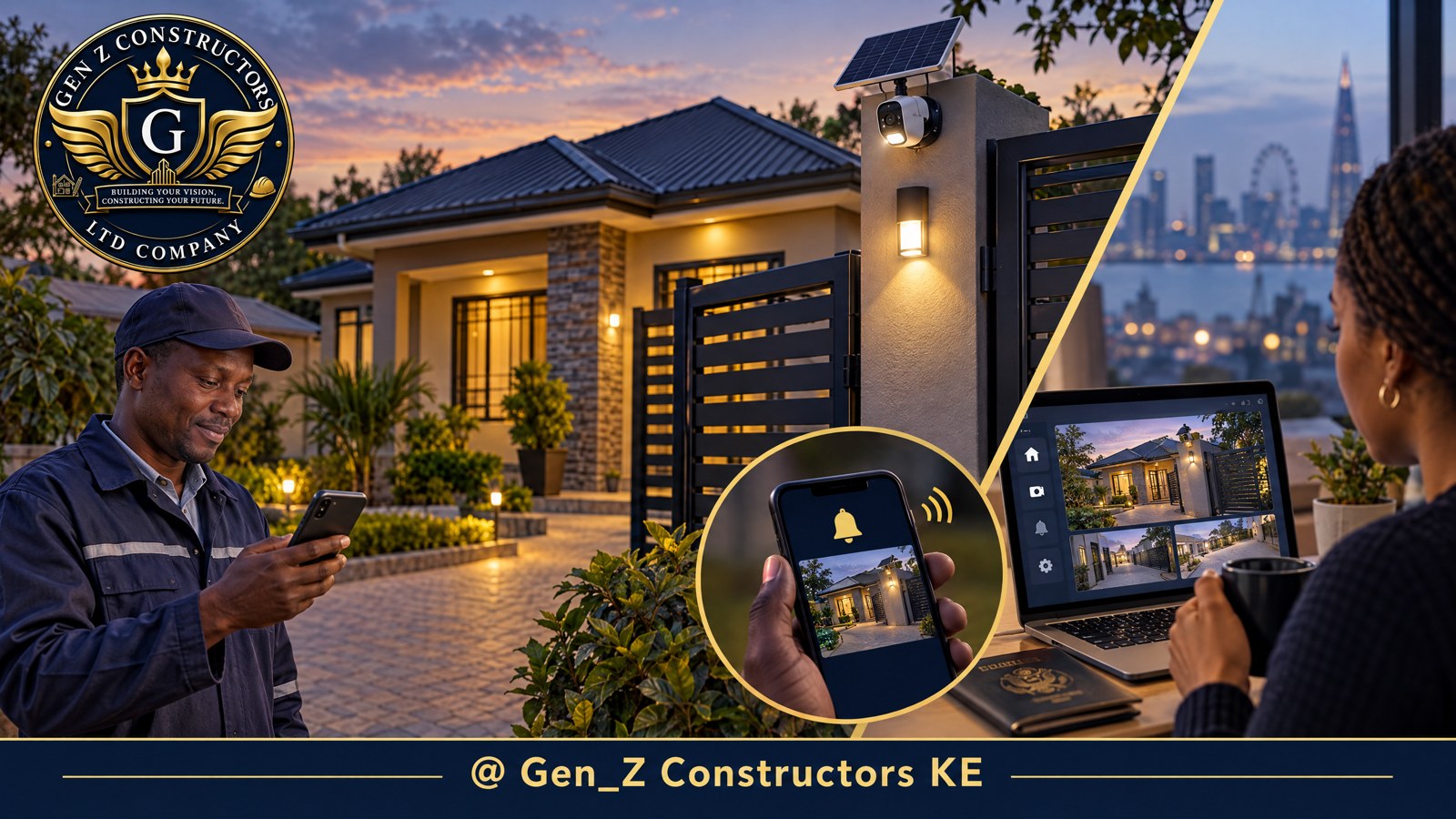
General planning information, not a guarantee against loss or a property-specific legal or security assessment. Manufacturer and provider references are examples, not endorsements or confirmed service coverage. The branded featured image is AI-generated and does not show an actual client property, installed security plan or live surveillance feed.
Written by
Gen-Z Constructors Team
Related Articles

How Drones, 360° Cameras, and WhatsApp Groups are Revolutionizing Remote Site Supervision in Nairobi
14 min read

Milestone-Based Construction Contracts: The Safest Way for Kenyans in the Diaspora to Pay for Building
14 min read

The Kenyan Diaspora Construction Handbook: How to Build Your Dream Home from Abroad with Zero Heartbreak
15 min read
Comments
No comments yet. Be the first to share your thoughts!